
Europe’s best young car mechanic has been crowned in a close contest;
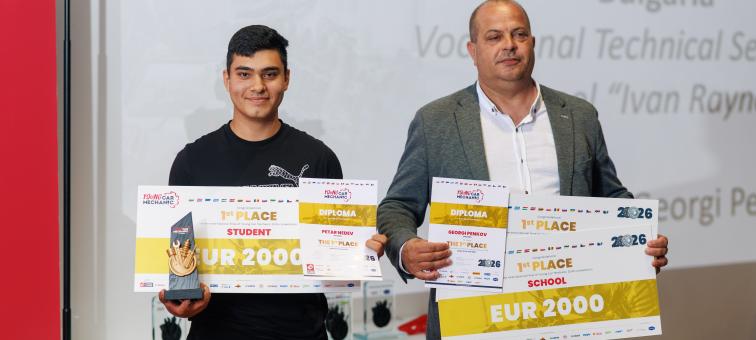
After 15 hands-on tasks and a close contest, the winner of the international Young Car Mechanic competition has been named. Petar Nedev from Bulgaria claimed the top spot, while the winner of the Latvian finals, Andris Lagzdiņš from Kandava Technical School of Agriculture, made the top six.
The Bulgarian scored 715 points in the competition, 23 ahead of the runner-up, Vadym Katenin, from Ukraine. The silver medallist, Katenin, scored 692 points. Tautvydas Janušis from Lithuania placed third with 685 points.
Meanwhile, the winner of the Latvian final, Lagzdiņš from Kandava, ranked sixth with 675 points. Asked about the greatest challenge, Lagzdiņš pointed out the air conditioner assignment – it was a task with a catch, and he ran out of time before he could solve it. It is worth noting that the competitors are allocated 45 minutes to solve all the tasks.
“Sixth place in this competition is a very respectable result, and Lagzdiņš certainly demonstrated his strengths,” said the organiser of the competition, Armands Umbraško, from Inter Cars Latvija. The overall performance of the competitors was impressive this year – scoring 45 points per task on average, which is the highest score in recent years, he added. “Of course, there are numerous factors at play here, some of which cannot be measured, and some may wonder if the judges have become more lenient or the tasks easier. Nevertheless, I believe that the overall level of the new car mechanics has increased; we see that they are capable of solving complex and tricky tasks. Without a doubt, credit is also due to their instructors, and the Young Car Mechanic competition both promotes the profession and raises the bar every year,” A. Umbraško added.
Andris Lagzdiņš revealed that he has already received a job offer from a well-respected garage and is looking forward to considering his future options following the summer break. “The competition definitely helps find work in the industry – after all, the labour market favours specialists who have already proven their ability,” added the student of Kandava Technical School of Agriculture.
Promotion for the industry, rather than just a competition
Latvia hosted the international Young Car Mechanic competition for the first time, thanks to last year’s victory by Niks Pētersons from Aizkraukle at the international finals in Croatia. This year’s competition in Riga ran for three days from 12 to 14 June. It involved students from 15 European countries contesting the title of the best mechanic at 15 stations placed at the Autobrava service garage. The competition featured participants from Bulgaria, Croatia, the Czech Republic, Estonia, Greece, Hungary, Latvia, Lithuania, Poland, Romania, Slovakia, Slovenia, Ukraine, Serbia, and Bosnia.
The tasks covered a range of topics, including the diagnostics and repair of driver assist systems, replacing the timing belt, repairing and servicing brakes, resolving battery faults, diagnostics and repair of an air conditioner, and EV battery diagnostics, just to name a few.
The event also featured the non-competitive NEW-OLD-CAR project, where a used Fiat was given a second lease of life, with competitors, judges, organisers, and instructors jointly restoring the car to donate it to charity later.
The overarching goal of the Young Car Mechanic competition is to advance technical education and motivate the young specialists to develop their skills, as well as to promote the image of the profession of car mechanic. The competition takes place in 15 countries simultaneously and attracts 3,200 participants from 260 schools across Europe. The total prize pool is worth 90,000 euros.
488 students from 13 vocational secondary schools, technical schools and colleges took part in this year’s first round in Latvia. In the first round, the students had to answer a hundred questions selected from various areas related to car repair. After the second (semi-finals) round, 12 future car mechanics from seven Latvian technical schools advanced to the Latvian national finals.